Your First Week on a Multi-Coin Pool, Screen by Screen
The first week decides whether a mining account becomes a tool or a source of anxiety. A 456 TH/s machine earns 0.00020456 BTC a day, about $17.32 before the listed fee and $16.63 after it, and there is very little to do beyond confirming that number and leaving the rest alone. Everything else on the dashboard is context.
Key takeaways
- 456 TH/s produces 0.00020456 BTC a day, worth $17.32 gross and $16.63 net of the listed 4%.
- Four times that hashrate, 1.824 PH/s, produces $69.30 gross and $66.53 net a day.
- PPS+ is the default scheme and settles hourly, while PPLNS waits for six confirmations.
- Pick a coin, name the worker clearly and set one alert; the rest of the settings can wait a week.
What a new account sees on day one
The first screen offers more than a newcomer needs. Hashrate, balance, worker list, coin selector, payout settings, referral links, an app download, a loan product and a calculator all compete for attention. None of them is urgent. A working install needs three choices: a coin, a worker name and a payout address.
It helps to treat the rest as reference material. The dashboard is not a control panel that must be optimised; it is a record of what the machines did. Once that distinction is clear, the first week becomes a short checklist instead of a tour of every feature, and the numbers start to mean something.
There is a practical reason to slow down. Changes made in the first hours are hard to attribute later: if the coin, the worker name and the payout address all changed on the same afternoon, a low balance the next morning could be any of the three. Make one change at a time and the dashboard becomes a diagnostic tool rather than a mystery.
Choosing a coin before choosing a worker
The pool supports more than twenty coins, including BTC, BCH, LTC with merged DOGE, KAS, ZEC, HNS, CKB and ETC. That breadth is useful and slightly disorienting. A machine is built for one algorithm, so the coin choice is really a choice about which hardware you own, not a menu to browse each morning.
Change the coin and the payout address has to change with it. A worker pointed at the wrong coin will submit valid shares and be credited in a currency the operator is not watching, which looks exactly like a machine that has stopped earning. Set the coin first, confirm the address matches it, then create the worker.
The same rule applies to merged mining. LTC and DOGE arrive together from one hash run, so a balance in a second currency is expected rather than a mistake. New operators sometimes report it as an error and go looking for a setting that does not exist.
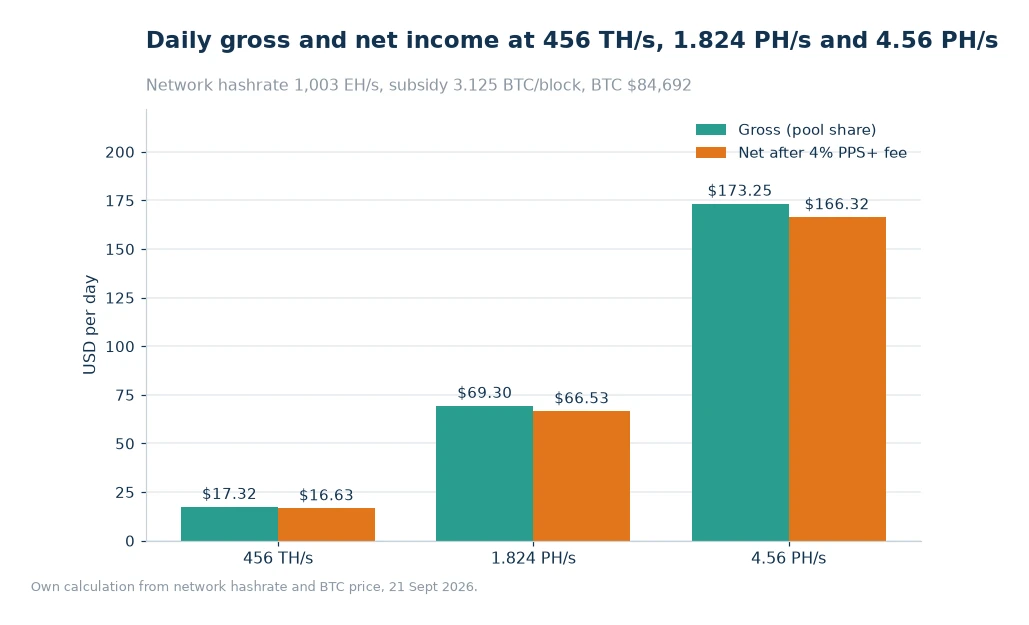
Daily gross and net at three sizes
The three rows scale by four and ten, so the same arithmetic can be checked at each size. Net applies the listed 4% to the block-reward component and leaves the transaction-fee side out of the comparison.
| Hashrate | BTC per day | Gross per day | Net per day |
|---|---|---|---|
| 456 TH/s | 0.00020456 | $17.32 | $16.63 |
| 1.824 PH/s | 0.00081824 | $69.30 | $66.53 |
| 4.56 PH/s | 0.00204564 | $173.25 | $166.32 |
A newcomer should find their own row before touching anything else. If the machine is 456 TH/s, the daily net figure is $16.63, and that is the number to compare with the power bill at the end of the week. Any other figure on the dashboard is either a projection or a different timescale, and confusing the two is the usual reason a first week feels disappointing.
Worked example
One calculation covers all three rows because they are simple multiples.
- Network rate per TH/s: 450 ÷ 1,003,000,000 = 0.00000044865 BTC each day.
- At 456 TH/s: 456 × 0.00000044865 = 0.00020456 BTC a day.
- Gross value: 0.00020456 × 84,692 = $17.32.
- Listed 4% on the block-reward component: 17.32 × 0.04 = $0.69.
- Net: 17.32 − 0.69 = $16.63.
- At 1.824 PH/s, four times the hashrate: 0.00081824 BTC a day, $69.30 gross and $66.53 net.
- At 4.56 PH/s, ten times: 0.00204564 BTC a day, $173.25 gross and $166.32 net.
Fees, payout scheme and the first invoice
The fee structure has one trap for the unwary: the headline rate is not a single deduction on everything. PPS+ lists 4% on the block-reward component and 2% on the transaction-fee component, while PPLNS lists 2% on both combined. Adding 4 and 2 to reach 6% is the most common arithmetic error in mining discussions, and it makes every comparison that follows slightly wrong.
Settlement timing differs too. PPS+ pays hourly against current difficulty, so the balance moves in small steps from the first hour. PPLNS waits for six confirmations and then divides by each miner's share of pool hashrate over the last five difficulty rounds, which produces larger and less frequent credits. The listed fee schedule is worth reading once, carefully, before choosing.
The app, alerts and the second screen
The dashboard is not where most miners spend their time. A phone alert is. The mobile app covers iOS and Android and shows live hashrate with alerts, plus multi-account management for operators with more than one site. Set one alert for a hashrate drop and ignore the rest of the notification settings for now.
A second screen is useful for a different reason: the pool is not the only source of truth. The facility or the machine's own interface reports temperature and fan speed, and comparing the two views catches problems that a hashrate chart alone would miss. A machine that holds hashrate while its fans run at full speed is a machine about to throttle.
Notifications deserve the same restraint as the dashboard. One alert for a hashrate drop and one for a balance that has not moved in a day cover most failures. Turning on every available notification produces a stream of messages that teaches the operator to ignore them, which is worse than having none at all. Choose two, and test that they actually fire before relying on them.
ViaBTC Bitcoin Mining is the account entry point, and the dashboard behind it is where the worker list, balance and coin settings live. Bookmark it, set the alert, and then close the tab. Checking twice a day is plenty for a stable installation.
Frequently asked questions
How much does a 456 TH/s machine earn per day?
About 0.00020456 BTC, or $17.32 at $84,692, before the listed 4% on the block-reward component. Net of that fee the figure is $16.63, with power costs still to be subtracted.
Should a new account choose PPS+ or PPLNS?
PPS+ is the default and pays hourly against current difficulty, which suits a first install because the balance moves predictably. PPLNS waits for six confirmations and produces larger, less frequent credits.
Why does the dashboard show a different number from the balance?
The dashboard often shows a projection for the current hashrate, while the balance records settled credits. Under PPS+ the balance updates hourly, so a partial day will always trail a full-day projection.
Do three things, then stop configuring
Pick the coin that matches the machine, confirm the payout address for that coin, and set one hashrate alert. Then wait a full day and compare the balance with 0.00020456 BTC at 456 TH/s. If the two agree, the account is set up correctly and further changes are optional. The first week is for confirming the path, not for perfecting it, and the second week is where the routine begins.
Sources: homepage, pricing and download pages at viabtc.com, covering account features, the 4% block-reward rate and the app builds[1]. Figures read 21 Sept 2026: 1,003 EH/s, 3.125 BTC per block, 144 blocks a day, BTC $84,692. Published 24 Oct 2026; daily income excludes power costs.