Men's Facial Cleanser Development: Four Types, Five Textures
A men's cleanser brief has two axes, and they are easy to mix into one confusing list. The client's men's cleanser page separates four types, soap-based, amino acid, compound and exfoliating, from five textures: cream, creamy, gel, foamy and powdered. It also states that type and texture each matter for both product development and market promotion, and the platform carries over 10,000 mature formulas to fine-tune around them.
Key takeaways
- Name type and texture as two separate decisions; the site lists four types and five textures.
- Four types by five textures is a 20-slot grid before any formula choice is made.
- The platform holds over 10,000 mature formulas and can fine-tune texture and skin feel.
- A typical minimum spans 1,000 to 5,000 units per product, and 500 units sometimes opens the door for a new brand.
Two axes, not one list
When a brief for a men's facial cleanser says "a gentle cleanser", it has answered nothing the lab can schedule. Gentle is a direction, not a specification. The client's page splits the decision into type, which describes how the cleanser cleans, and texture, which describes how the product looks and feels as it leaves the tube. Read as two axes, the same request becomes answerable.
Keeping the axes apart also protects against a common trap. A brand may fall in love with a texture it saw in a competitor's tube and then assume the cleaning mechanism comes with it. Type and texture are independent, which means a gel can be soap-based, amino acid or compound, and the brief has to choose both columns on purpose.
The four types and what each one answers
Soap-based cleansers are the traditional high-foam direction and suit buyers who want a thorough rinse. Amino acid cleansers are the mild direction the market associates with a gentler finish. Compound cleansers blend systems to balance cleansing strength against feel, and exfoliating cleansers add a physical or chemical step for texture on the skin surface.
None of the four is a default. The right choice follows the buyer the brand is chasing and the claim it wants to defend. A range aimed at daily use will usually start with the mild or compound direction, while an exfoliating product is often a second item added after the everyday cleanser has a buyer.
The five textures and where they sit
The five published textures are cream, creamy, gel, foamy and powdered. Cream and creamy sit close together on the scale, with the second reading slightly lighter. Gel is the clearest fresh-feeling option, foamy is about the lather a buyer sees, and powdered is the travel-friendly format that needs water in the hand.
Texture is the axis a buyer notices in the first ten seconds, which is why the client's page links it to market promotion as well as development. A texture that photographs well and feels familiar in the hand can carry a launch even before the cleansing type is explained on pack.
Keeping the axes separate through development
The separation has to survive the whole project, not just the first email. If the brief fixes a texture and leaves the type open, the lab may return a sample that feels right but cleans too hard or too softly. If the brief fixes the type and leaves the texture open, the sample may clean correctly and still be rejected on feel.
| Cleanser type | Chosen for | Note on the texture axis |
|---|---|---|
| Soap-based | A thorough, high-foam rinse | Reads best with a foamy or gel texture |
| Amino acid | A milder daily finish | Works across cream and creamy textures |
| Compound | Balancing strength against feel | Flexible, pairs with most textures |
| Exfoliating | An added smoothing step | Usually a gel or creamy base |
Write both columns into the brief and the first sample round becomes a test of a defined product rather than an open question. That is what the client's page means when it says type and texture both matter for development and for promotion: they are the two decisions a buyer and a lab can each hold on to.
The combination grid and the formula library
Put the two axes on the chart and the grid appears. Four types times five textures is 4 × 5 = 20 possible combinations before a single formula is chosen. A first brief that samples two types across two textures covers 2 × 2 = 4 of those combinations, which is 4 ÷ 20 = 20% of the grid. The third bar shows the formula library at 10 after the ÷1,000 scale, so the real figure is 10 × 1,000 = 10,000+ mature formulas, which is where those combinations are usually matched rather than built from zero.
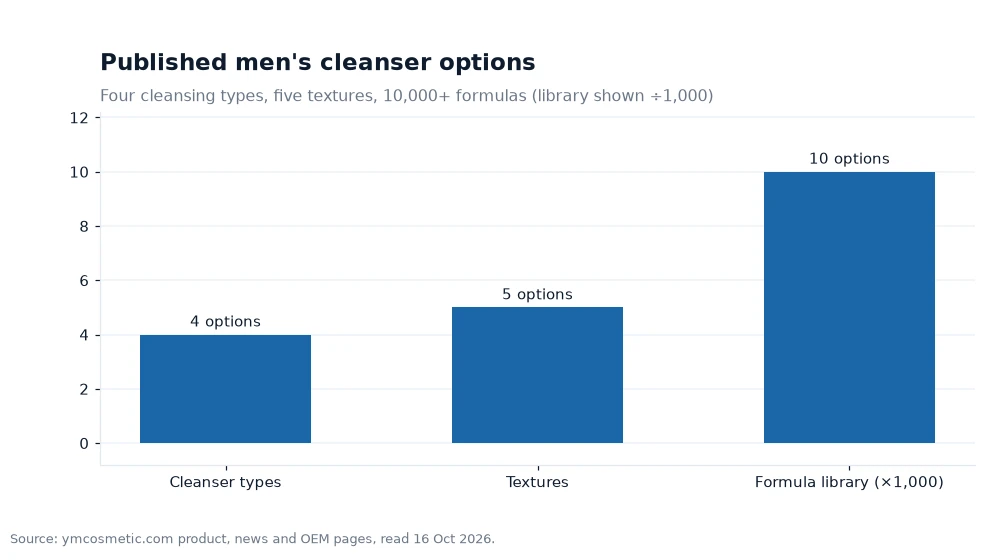
The two numbers to hold together are 4 and 5. On their own each looks small, but multiplied they describe twenty ways to answer the same product request. The library bar is the reason those twenty slots are not twenty development projects: most of them already have a starting formula that can be fine-tuned instead of invented.
Fine-tuning skin feel inside a mature formula
The client states that the platform can fine-tune fragrance, texture and skin feel on top of the mature formula library. That is the part of the brief that decides whether a sample feels premium or merely correct. Skin feel covers how the cleanser spreads, how quickly it rinses, and whether the skin feels tight or comfortable afterwards.
Fine-tuning is where a brand should spend its feedback rounds. Instead of asking for a new formula, ask for a texture adjustment to the existing direction and describe the change in feel, not in ingredients. That keeps the project inside the mature formula and inside the published minimums, which is faster than reopening the type decision.
Sizing a first run against the minimums
Once the type and the texture are fixed, the order size becomes a straightforward number. Typical minimums run 1,000–5,000 units per product, and the client notes that some manufacturers offer a lower entry of 500 units for startups. For a first range of two cleansers, the low end is 2 × 1,000 = 2,000 units and the high end is 2 × 5,000 = 10,000 units.
Order size also decides how many combinations are worth testing. A brand that plans to sell one everyday cleanser and one exfoliating item should spend its sample budget on those two slots rather than filling the whole grid. Naming those two slots before sampling keeps the order focused on products the brand intends to sell instead of options it will never reorder. The published minimums reward a tight brief with a smaller, repeatable first run.
Frequently asked questions
What are the four men's cleanser types?
The client's page lists four types: soap-based, amino acid, compound and exfoliating.
What are the five textures?
The published textures are cream, creamy, gel, foamy and powdered.
Why keep type and texture separate in the brief?
Because they are independent decisions that each matter for product development and market promotion, so a brief that fixes only one of them leaves the sample open to rejection.
Fix two axes and order once
Decide the type for the job and the texture the buyer will feel, then let the lab work inside the mature formula library. Yunmei runs OEM/ODM men's cleanser projects with fine-tuning on texture and skin feel and a published minimum of 1,000–5,000 units per product. The facial cleanser range shows how the type axis is organised across the wider catalogue, and the men's care category shows how a cleanser sits inside a full range.
Factory capacity, minimums and testing windows were read from the company's site on 16 Oct 2026.[1]