The Export Document Sequence for a Perfume Drop, Step by Step
Export documents are not a checklist to be collected at the end of a project; they are a chain in which each item depends on something that must exist before it. The formula has to be fixed before the safety assessment is meaningful, the assessment has to exist before the label can carry its claims, and the label has to be approved before production packaging can be printed. Sequencing the chain correctly, and knowing where it can flex, is what keeps a fixed launch date achievable.
Key takeaways
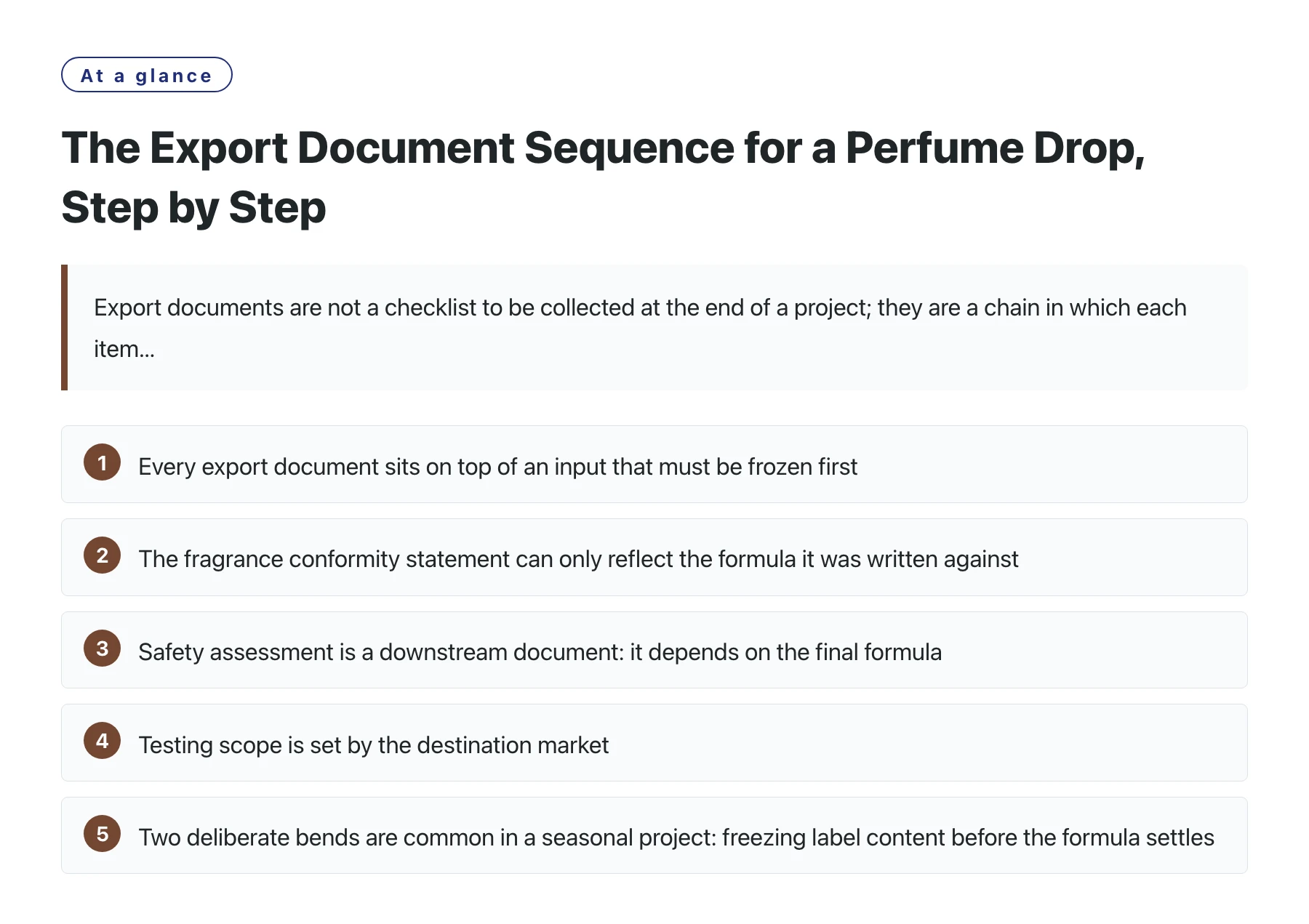
- Every export document sits on top of an input that must be frozen first, which means the order of work matters more than the list of items.
- The fragrance conformity statement can only reflect the formula it was written against, and the underlying industry Standards are revised periodically, so the statement has a shelf life [1].
- Safety assessment is a downstream document: it depends on the final formula, the intended use and the packaging, and it cannot be completed earlier by working harder [2].
- Testing scope is set by the destination market, so it should be scoped before production rather than discovered at the port [3].
- Two deliberate bends are common in a seasonal project: freezing label content before the formula settles, or accepting a partial assessment on a nearly final formula. Both are manageable when they are planned and expensive when they are accidental.
A brand preparing a seasonal drop usually has a fixed shelf date and a flexible start date, which is the opposite of how documentation behaves. Documents want a settled product; the calendar wants the product settled later.
The resolution is to think in gates rather than tasks. At each gate something becomes fixed, and once it is fixed the documents that depend on it can move forward. This sequence is the one that most often matches how a factory and an assessor actually work.
Why order beats inventory
A documentation inventory answers a comfortable question: which items exist? A documentation sequence answers a harder one: which items are blocked? In practice, almost every late document in a fragrance project is blocked by something upstream rather than by a lack of effort.
The dependency structure is simple enough to hold in your head. Product definition comes first, then the declaration of what is in the product, then the assessment of that declaration, then the label that communicates it, then the paperwork that moves it. Each stage consumes the previous one. A manufacturer or partner that publishes how it structures this work, such as the process described on the official Xuelei website, gives you a place to check the sequence against a real one rather than an imagined one.
Look for the input, not the owner
When a document is late, the useful question is not who is responsible but what they are waiting for. An assessor waiting on a final formula, a printer waiting on approved artwork and a forwarder waiting on a confirmed volume are all the same problem in different clothes.
The sequence, gate by gate
- Market and product scopeFix the destination markets and the product category first, because they determine which obligations apply and which testing is in scope.
- Formula freezeRecord the exact formula version that will be produced, including dosage, and treat any later change as a new version with its own review.
- Compound conformity statementRequest a statement against the current industry Standards for the product category, issued against the frozen version [1].
- Ingredient and allergen declarationReconcile trade names, INCI names and internal codes into a single naming table that every later document will use.
- Safety assessmentCommission the assessment on the frozen formula, intended use and packaging; this is the gate that most often sets the real critical path [2].
- Label and artwork approvalOnce the assessment is in, finalise claims, allergen information and required statements, then approve artwork in writing.
- Production records and shipment packAfter the run, collect the batch record, certificate of analysis and retained sample, then complete commercial and transport documents against the approved label.
Where the sequence usually stalls
| Gate | Document that should emerge | What blocks it | Cost of a late fix |
|---|---|---|---|
| Formula freeze | Versioned formula reference | Development changes continuing after approval | Every downstream document has to be reissued |
| Conformity statement | Statement for the category and dosage | Compound data supplied under a trade name only | Reformulation or a delayed shipment |
| Safety assessment | Assessment for the finished product | Packaging and intended use not yet defined | Label cannot be finalised, so printing slips |
| Artwork approval | Signed label proof | Claims still under discussion | Reprint cost and a missed production slot |
| Testing | Test reports for the destination market | Scope agreed late or narrowly | Shipment held while testing is arranged [3] |
| Shipment pack | Invoice, packing list, transport documents | Goods description that does not match the label | Customs query and a delayed container |
Notice that only one row in the table is about a missing document. The rest are about documents that cannot be produced yet, which is why chasing paperwork late in a project has such a poor return.
The two points where the sequence bends
Perfect sequencing is not always available when the launch date is fixed. There are two bends that experienced teams use deliberately, and both have a price.
Freezing the label before the formula settles
If printing has to start early, the label content can be frozen against the expected formula while the assessment is still in progress. This works when the remaining development is limited to dosage or minor materials, and it must be recorded as a risk with a named owner. If the formula subsequently moves, the label is the item that has to be reprinted.
The alternative is to plan the launch around the assessment rather than the printer, which is often cheaper. A manufacturer organised as fragrance manufacturing under one roof can usually state how late a formula can change before packaging is affected, and that answer is the one that decides which bend is available.
Starting the assessment on a nearly final formula
Assessors can begin work on a formula that is expected to change in a defined way, provided the change is specified in advance. This shortens the critical path without pretending that the formula is final. What it cannot do is cover an open-ended development process, which is why the bend only works when the remaining variables are few and named.
For a first-time brand the sequence itself is the deliverable, because a documented order of work is what makes a second season faster. Understanding the steps behind a new fragrance brand before the first brief turns the documentation chain from an obstacle into a schedule.
Write the sequence on one page with the market obligations, the category Standards and the destination testing scope attached, then have the factory and the assessor agree it. A sequence that both sides have seen is far harder to derail than one held privately by the brand team, especially when a launch date is immovable.
Sources
- IFRA Standards Library (International Fragrance Association) —— The IFRA Standards Library lists the restrictions the fragrance industry applies to individual fragrance ingredients, based on safety assessments; it is the reference point for compliant fragrance formulation.
- EU Scientific Committee on Consumer Safety (SCCS) —— The EU scientific committee that issues opinions on the safety of cosmetic ingredients, including fragrance allergens and their labelling thresholds.
- SGS: Cosmetics, Personal Care & Household Testing —— Testing, inspection and certification services for cosmetics and personal care, including microbiological, stability and safety testing aligned with cosmetics GMP.
Frequently asked questions
Which export document takes the longest to obtain?
Usually the safety assessment, because it cannot begin in earnest until the formula, the intended use and the packaging are defined. Testing can also be long when its scope is agreed late. Both are downstream documents, so their duration is largely set by how early the upstream inputs were frozen.
Can documents be prepared in parallel?
Some can. Commercial and transport documents run in parallel with production, and the ingredient naming table can be built while development continues. The chain that cannot be parallelised is formula, declaration, assessment and label, because each genuinely needs the previous one.
What happens if the formula changes after the safety assessment?
The change has to be assessed, and any affected document — the assessment, the allergen declaration, the conformity statement and possibly the label — must be revisited. Treating the change as a new version rather than an edit keeps the review honest and the file auditable.
Do all destinations require the same testing?
No. Testing scope follows the market's requirements and the product category, so a report prepared for one destination may not satisfy another. Agree the scope with the market list in front of you rather than assuming a single pack travels everywhere.
How should a first-time brand sequence a seasonal drop?
Fix the market list, freeze the formula as early as development allows, and let the assessment and the label drive the calendar. Where the launch date forces a bend, choose the bend deliberately, write down the risk and give it an owner.